The Evolution of Modern Money
Discover the fascinating journey from traditional paper banknotes to the new generation of polymer currency.
A simple guide to understanding plastic money, its history, benefits, global success, and India’s possible currency revolution.
FROM PAPER TO POLYMER
The Evolution of Modern Money
How plastic banknotes are changing the way the world handles cash
From the first paper notes to today’s smart and highly secure polymer banknotes, money has constantly changed with technology.
Now, India is preparing to test polymer ₹10 and ₹20 notes.
Is this the beginning of a new chapter for Indian currency?
Let’s find out.
INTRODUCTION
Money Is Changing Again
Imagine taking a banknote out of your pocket after a heavy rain.
It is wet.
You try to dry it.
The note becomes dirty, weak and wrinkled.
Now imagine a banknote that can handle water, sweat, dirt and everyday use much better.
That is the basic idea behind polymer currency.
Polymer banknotes are sometimes called plastic money, but they are not ordinary plastic. They are made from a special, thin polymer material designed specifically for currency.
Countries around the world have already experimented with or adopted polymer banknotes.
Australia was the pioneer. Its experience helped show that currency could become more durable, secure and modern.
Now India is preparing to test polymer ₹10 and ₹20 notes.
WHAT IS POLYMER CURRENCY?
What Exactly Is a Polymer Note?
A polymer banknote is a banknote made from a special synthetic polymer substrate instead of traditional cotton-based paper.
It looks and feels different from an ordinary paper note.
One of its most noticeable features is that it can contain a clear transparent window.
This window can contain special security elements that are difficult to reproduce.
Polymer notes are also:
- More resistant to water
- More resistant to tearing
- More resistant to dirt
- More durable
- Suitable for advanced security features
- Potentially recyclable after their useful life
But polymer notes are not perfect.
They cost more to produce initially, and countries need special printing technology and equipment.
So the real question is not simply:
“Is polymer better than paper?”
The better question is:
“Does its longer life and better security justify the additional cost?”
THE EARLY HISTORY OF BANKNOTES
Before Plastic Money
For thousands of years, people used many things as money.
Coins made from metals such as gold, silver and copper became common because they were durable and easy to recognize.
Paper money came much later.
China played an important role in the early development of paper currency.
Over time, paper banknotes became popular because carrying large amounts of metal coins was difficult.
Governments and central banks gradually developed better printing techniques.
Security features were added to prevent forgery.
But paper has a natural weakness.
It gets damaged.
A banknote may pass through thousands of hands during its life.
It can become wet, folded, dirty or torn.
As economies grew, governments began looking for better materials.
This search eventually helped lead to polymer banknotes.
WHY DID COUNTRIES LOOK FOR SOMETHING BETTER?
The Problem With Paper
Paper banknotes are useful, but they have several weaknesses.
Think about a ₹10 or ₹20 note.
These low-value notes often move very quickly from person to person.
A shopkeeper receives one.
A customer spends it.
A bus conductor receives it.
A vegetable seller receives it.
A child may use it to buy something.
After thousands of such transactions, the note becomes dirty and damaged.
Central banks must remove worn-out notes and replace them with new ones.
That means:
More printing.
More transportation.
More processing.
More destruction of damaged notes.
More cost.
There was another major concern:
Counterfeiting.
As printing technology became better, counterfeiters also gained access to better equipment.
Central banks therefore wanted banknotes that could offer stronger security.
Polymer became one possible answer.
AUSTRALIA: THE BEGINNING OF THE POLYMER REVOLUTION
Australia Leads the Way
Australia is widely recognized as the pioneer of modern polymer banknotes.
The Reserve Bank of Australia and Australia’s CSIRO worked together to develop new banknote technology.
In 1988, Australia issued a commemorative $10 polymer banknote for its bicentenary.
It was a major experiment.
The note used polymer and included advanced security technology.
The experiment was successful.
Australia then developed a complete polymer banknote series.
Between 1992 and 1996, Australia progressively introduced polymer notes across its currency denominations.
By 1996, Australia had become the first country to convert its entire circulating banknote series from paper to polymer.
This was a major milestone in the history of money.
THE AUSTRALIAN SUCCESS STORY
What Did Australia Discover?
Australia’s experience showed that polymer could survive everyday handling much better than traditional paper.
The Reserve Bank of Australia found that polymer notes could have much longer useful lives.
For example, its research found average lifetimes of around:
- 5 years for $5 and $10 notes
- 10 years for $20 notes
- 15 years for $50 notes
Actual life varies depending on denomination and usage.
This is important because a note that lasts longer does not need to be replaced as frequently.
Australia also found other advantages.
Polymer notes are resistant to moisture, dirt and oils.
They can also incorporate sophisticated security features.
The Australian experience became an important reference point for other countries considering polymer currency.
WHICH COUNTRIES USE POLYMER BANKNOTES?
A Global Movement
Polymer currency is no longer an Australian experiment.
Many countries have adopted polymer banknotes in some form.
Examples include:
Australia
A complete polymer currency system.
Canada
Canada introduced polymer banknotes across its major denominations.
United Kingdom
The Bank of England introduced polymer £5, £10 and £20 notes.
New Zealand
New Zealand uses polymer banknotes.
Singapore
Singapore has issued polymer notes alongside its other currency formats.
Malaysia
Malaysia has used polymer banknotes for selected denominations.
Brunei
Brunei has used polymer currency.
Thailand
Thailand has introduced polymer banknotes.
Mexico
Mexico has used polymer material for selected denominations.
Several other countries
Countries across Asia, Africa, Latin America and the Caribbean have also issued polymer notes.
The exact denominations and extent of polymer use differ from country to country.
Research literature has reported polymer banknotes being adopted by more than 50 countries in various forms.
WHY DID THESE COUNTRIES ADOPT POLYMER?
Three Major Reasons
Most countries consider polymer banknotes for three main reasons.
1. Durability
Polymer notes can survive everyday handling for longer.
2. Security
Polymer allows special security features such as transparent windows and other optical elements.
3. Long-Term Economics
Polymer notes generally cost more to manufacture initially.
However, because they can last longer, the total cost over their useful life may be lower.
Australia’s research specifically examined the cost-benefit question and found that the longer lifespan can reduce production, transportation, processing and replacement costs.
So polymer is not simply about making a “plastic note.”
It is about changing the economics and security of physical cash.
POLYMER VS PAPER
Which Is Better?
Let’s make a simple comparison.
| Feature | Paper Currency | Polymer Currency |
|---|---|---|
| Water resistance | Limited | Much better |
| Durability | Moderate | High |
| Tear resistance | Lower | Higher |
| Dirt resistance | Lower | Higher |
| Security features | Advanced | Highly advanced possibilities |
| Initial production cost | Lower | Usually higher |
| Useful life | Shorter | Usually longer |
| Recycling | Limited | Possible |
| Feel | Familiar | Different |
However, polymer does not automatically eliminate counterfeiting.
Counterfeiters continue to improve their methods.
The real advantage is that polymer provides central banks with additional security possibilities.
THE AMAZING CLEAR WINDOW
A Window Inside Your Money
One of the most recognizable features of polymer banknotes is the transparent window.
Look at a polymer note against the light.
You may see a clear section containing printed or optical security features.
Why is this useful?
Because reproducing a genuine transparent window with all its special details can be difficult.
The window can become an important authentication feature.
Australia’s polymer currency uses transparent windows as part of its security design.
The Reserve Bank of Australia says polymer enabled the introduction of security features that helped make its notes harder to counterfeit.
For ordinary people, this can make checking a note easier.
Instead of depending on one security feature, people can check several features together.
OTHER SECURITY FEATURES
More Than Just a Plastic Window
Modern banknotes can contain many security features.
These may include:
- Transparent windows
- Holographic elements
- Special inks
- Fine-line printing
- Microprinting
- Tactile features
- Ultraviolet features
- Colour-changing elements
- Complex patterns
- Machine-readable security features
Polymer provides a useful platform for combining several of these technologies.
This creates a layered security system.
Think of it like a house.
A house is safer when it has:
A strong door.
A good lock.
An alarm.
Security cameras.
And proper lighting.
Similarly, a banknote becomes harder to copy when it contains several different security features.
ARE POLYMER NOTES REALLY WATERPROOF?
The Famous Water Test
You may have seen videos showing polymer banknotes surviving water.
There is some truth behind this.
Polymer is much more resistant to water than ordinary paper-based banknotes.
This is particularly useful in countries with:
- Heavy rainfall
- High humidity
- Coastal climates
- Frequent outdoor transactions
India has a wide range of climates.
From the humid coasts to the monsoon regions, banknotes can face difficult conditions.
A more water-resistant note could therefore be useful.
But remember:
Water-resistant does not mean indestructible.
The printing, security features and note itself can still be damaged by extreme conditions or improper handling.
THE ENVIRONMENTAL QUESTION
Is Plastic Currency Good for the Environment?
This is a complicated question.
At first, the words “plastic money” may sound environmentally unfriendly.
But the story is more complex.
Polymer notes can last much longer than paper notes.
That means fewer notes may need to be produced and transported over the same period.
At the end of their useful life, polymer notes can also be processed for recycling.
The Reserve Bank of Australia says its polymer banknotes can be granulated and recycled into plastic products.
However, polymer is still a synthetic material.
Therefore, recycling and responsible disposal are important.
The environmental result depends on the complete life cycle:
Production → Transportation → Use → Collection → Disposal/Recycling
THE COST OF POLYMER MONEY
Is It More Expensive?
Yes, initially.
Polymer substrate generally costs more than traditional paper banknote material.
That can make the first production run more expensive.
But this is only one part of the calculation.
Imagine two shoes.
Shoe A costs ₹500 but lasts one year.
Shoe B costs ₹900 but lasts three years.
Which shoe is cheaper?
You cannot decide by looking only at the purchase price.
The same idea applies to banknotes.
A polymer note may cost more to manufacture but may remain in circulation longer.
Australia’s experience indicates that longer life can generate savings in printing, transportation, processing and replacement.
POLYMER CURRENCY IN INDIA
India’s Long Journey Toward Plastic Notes
India has considered polymer currency before.
The idea is not completely new.
India has previously explored polymer notes, particularly because low-value notes can become dirty and damaged quickly.
But large-scale adoption did not happen at that time.
Now the idea has returned.
And this time, India is moving toward field trials.
Recent announcements from the Reserve Bank of India indicate that the government has approved trials of polymer ₹10 and ₹20 banknotes.
The reason for beginning with these denominations makes practical sense.
₹10 and ₹20 notes are frequently used for everyday transactions.
They can therefore provide a good real-world test of durability.
INDIA’S UPCOMING ₹10 AND ₹20 POLYMER NOTES
What We Know So Far
According to recent reports, India is preparing a major field trial.
The planned pilot involves approximately:
₹10 Polymer Notes
1 billion notes
₹20 Polymer Notes
1 billion notes
Total
2 billion polymer notes
The reported objective is to test the notes under real-world conditions.
The RBI will be able to observe:
- How long they last
- How people handle them
- How merchants accept them
- How ATMs and machines handle them
- How well security features work
- How the public responds
- Whether the economics make sense
The reports indicate that wider circulation will depend on the success of the trials.
IMPORTANT: WHAT WILL INDIA’S NEW NOTES LOOK LIKE?
Don’t Believe Every Picture You See Online!
This is an important point.
You may see beautiful pictures online claiming to show:
“New Indian Plastic Note”
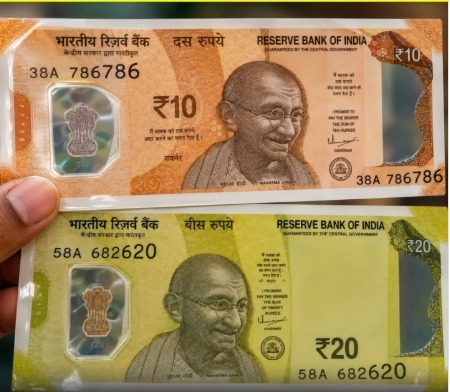
Be careful.
As of August 8, 2026, official reporting confirms the planned polymer trials, but that does not mean every concept image circulating online is an official RBI design.
Some images on social media are fan-made or AI-generated concepts.
WHY INDIA MAY BENEFIT
India’s Special Situation
India is one of the world’s largest economies.
Cash remains important, especially for everyday transactions.
Small-value notes are frequently used in:
- Local markets
- Small shops
- Public transport
- Tea stalls
- Street vendors
- Rural areas
- Small businesses
- Daily household purchases
These notes can experience heavy wear.
A more durable material could potentially reduce the frequency with which damaged notes have to be replaced.
Polymer could also help improve authentication through advanced security features.
However, India’s size creates a major challenge.
A solution that works in Australia may need modifications for India.
India must test the notes in real Indian conditions.
THE FUTURE OF POLYMER CURRENCY IN INDIA
What Could Happen Next?
There are several possible scenarios.
Scenario 1: Successful Pilot
If the ₹10 and ₹20 trials perform well, India could consider regular issuance.
Scenario 2: Limited Polymer Use
India could continue using paper for some denominations and polymer for selected high-use denominations.
Scenario 3: Design Improvements
The pilot could reveal problems.
The RBI could then modify the material, design or security features.
Scenario 4: Wider Adoption
If polymer proves durable, secure and economically useful, more denominations could eventually be considered.
But one thing is important:
Polymer currency does not mean paper currency will disappear overnight.
Recent reports specifically indicate that the existing paper currency is not being immediately replaced.
POLYMER MONEY AND DIGITAL PAYMENTS
Will Plastic Notes Compete With UPI?
India is already a leader in digital payments.
Millions of people use:
- UPI
- Mobile banking
- Debit cards
- Credit cards
- Digital wallets
So why introduce polymer notes?
Because digital payments and physical cash serve different needs.
A street vendor may accept cash.
A small child may use cash.
Someone without a smartphone may need cash.
A person in an area with poor internet access may depend on physical money.
Therefore:
Digital money and polymer money can exist together.
The future of money may not be:
Cash OR digital.
It may be:
Cash AND digital.
THE BIG ADVANTAGES
Why Polymer Currency Is Attractive
Let’s summarize the biggest advantages.
1. Longer Life
Polymer notes can remain usable for longer.
2. Water Resistance
They handle moisture better.
3. Better Durability
They are harder to tear through normal handling.
4. Advanced Security
They can include transparent windows and other sophisticated features.
5. Cleaner Surface
Their surface can be less absorbent than traditional paper.
6. Potential Cost Savings
Longer life can reduce replacement requirements.
7. Recycling
Used polymer notes can potentially be recycled.
8. Modern Appearance
Polymer allows innovative designs and security elements.
These advantages explain why many central banks have explored polymer currency.
THE DISADVANTAGES
Polymer Is Not Perfect
Every technology has disadvantages.
Higher Initial Cost
Polymer notes can cost more to manufacture.
Special Handling
Cash machines and equipment may need to be compatible with the new notes.
Different Feel
Some people may find polymer notes slippery or unfamiliar.
Heat and Folding Issues
Improper handling and extreme conditions can affect polymer notes.
Recycling Infrastructure
A proper system is needed to collect and recycle used polymer notes.
Counterfeiting Still Exists
Polymer makes counterfeiting harder, but it does not make counterfeiting impossible.
Therefore, India should carefully study both advantages and disadvantages before expanding the system.
WHAT CAN INDIA LEARN FROM AUSTRALIA?
A Lesson From the Pioneer
Australia’s experience provides several useful lessons.
First:
Test Before Expanding.
Australia began with experimental technology and then moved toward a complete series.
Second:
Security Must Keep Improving.
Counterfeiters also learn.
So security features must evolve.
Third:
Durability Matters.
A longer-lasting note can reduce the number of notes that need replacement.
Fourth:
Public Acceptance Matters.
A currency is successful only when ordinary people can use it easily.
Finally:
Think Long Term.
The decision should not be based only on the cost of printing one note.
The complete life cycle should be considered.
Australia’s experience demonstrates that polymer can work at national scale.
THE FUTURE OF MONEY
From Paper to Polymer to Digital
Money has always evolved.
We moved from:
Barter → Coins → Paper Money → Plastic Cards → Mobile Payments → Digital Currency
Now polymer banknotes are becoming another part of this evolution.
But polymer is not necessarily the final stage.
The future may contain several forms of money at the same time.
You may have:
Cash in your wallet.
A card in your pocket.
UPI on your phone.
Digital currency in your digital wallet.
The important point is that money changes when technology, society and people’s needs change.
India’s polymer experiment could become another important chapter in this long story.
CONCLUSION
A NEW CHAPTER FOR INDIAN MONEY
For centuries, money has changed with human progress.
Metal coins replaced older forms of exchange.
Paper notes made money easier to carry.
Plastic cards changed the way we paid.
Smartphones brought payments into our hands.
And now, polymer banknotes are giving physical cash a technological upgrade.
Australia demonstrated that polymer currency can work successfully at national scale.
Other countries followed.
Now India is preparing to conduct its own major test with polymer ₹10 and ₹20 notes.
Will polymer currency completely replace paper money in India?
Nobody can say that today.
The answer will depend on the results of the trials, public acceptance, security, cost and long-term performance.
But one thing is certain:
Money is changing.
And India’s journey from paper to polymer could become one of the most interesting chapters in the evolution of modern currency.
The future of money may not be paper OR plastic.
It may be paper, polymer AND digital — working together.
The currency of tomorrow is already being tested today.
For more interesting information click here
What’s up, for all time i used to check weblog posts here early in the morning, for the reason that i love to gain knowledge of more and more.
Valuable info. Lucky me I discovered your web site by
chance, and I am stunned why this coincidence didn’t took place in advance!
I bookmarked it.
An intriguing discussion is worth comment. I believe that you should publish
more on this topic, it might not be a taboo matter but generally people
do not speak about such issues. To the next! Kind regards!!
I do accept as true with all of the ideas you’ve presented in your
post. They’re really convincing and will definitely
work. Nonetheless, the posts are too brief for newbies.
May just you please prolong them a bit from subsequent time?
Thank you for the post.
I’m not that much of a internet reader to be honest but your
blogs really nice, keep it up! I’ll go ahead and bookmark your website to come
back down the road. Cheers
It’s a shame you don’t have a donate button! I’d
definitely donate to this superb blog! I suppose for now i’ll settle for book-marking and
adding your RSS feed to my Google account. I look forward to fresh updates and will talk about this website with my Facebook group.
Chat soon!
of course like your web site however you have to check the spelling on several of your posts.
Many of them are rife with spelling issues and I in finding
it very troublesome to inform the truth however
I’ll definitely come back again.
The other day, while I was at work, my cousin stole my iPad and tested
to see if it can survive a twenty five foot drop, just so she can be a youtube sensation.
My iPad is now destroyed and she has 83 views. I know this is entirely
off topic but I had to share it with someone!
Undeniably believe that which you stated. Your
favorite justification seemed to be on the internet the easiest thing to be aware of.
I say to you, I certainly get irked while people think about worries that they just don’t know about.
You managed to hit the nail upon the top and also defined out the
whole thing without having side effect , people can take a signal.
Will likely be back to get more. Thanks
Amazing blog! Is your theme custom made or did you download it
from somewhere? A design like yours with a few simple adjustements
would really make my blog jump out. Please let me know where you got your
design. Bless you
That is a really good tip especially to those new
to the blogosphere. Short but very precise info… Appreciate your
sharing this one. A must read article!
These are truly enormous ideas in concerning blogging. You have touched
some fastidious points here. Any way keep up wrinting.
Thank you for the good writeup. It in fact
was a amusement account it. Look advanced to far added agreeable from you!
By the way, how can we communicate?
Hello there! This post couldn’t be written any better!
Reading through this post reminds me of my good old room
mate! He always kept chatting about this. I will forward this post to him.
Pretty sure he will have a good read. Thank you for sharing!
Pretty section of content. I just stumbled upon your web site and in accession capital to assert that I acquire in fact enjoyed account your blog posts.
Any way I’ll be subscribing to your augment and even I achievement you access consistently fast.
I just couldn’t go away your site before suggesting that I really
loved the usual info an individual provide on your guests?
Is gonna be back steadily to check up on new posts
Howdy just wanted to give you a quick heads up.
The words in your article seem to be running off the screen in Opera.
I’m not sure if this is a format issue or something to do
with browser compatibility but I figured I’d post to let you know.
The layout look great though! Hope you get the issue solved soon. Cheers
Hello very cool web site!! Guy .. Excellent .. Superb ..
I’ll bookmark your site and take the feeds additionally?
I am happy to search out so many helpful information right here within the submit,
we want work out extra techniques on this regard, thank
you for sharing. . . . . .
It’s remarkable to go to see this site and reading the views of all friends concerning this
piece of writing, while I am also keen of getting familiarity.
Great post. I used to be checking continuously this weblog and I am impressed!
Extremely useful information specially the closing part 🙂 I take care of such info much.
I was seeking this certain information for a very lengthy time.
Thanks and best of luck.